Capturing the Serengeti: A Watercolor Journey for Designers
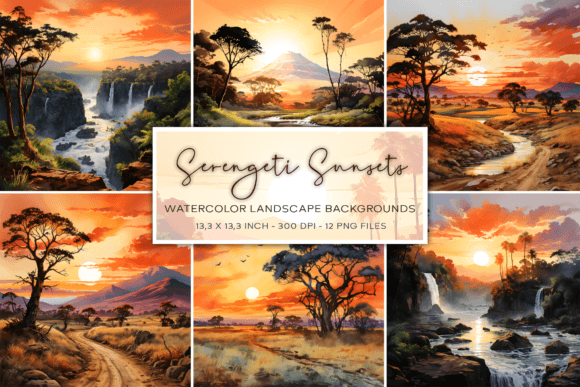
There is a specific kind of creative fatigue that sets in when you spend too much time staring at flat, digital vectors. We all crave texture, especially in a world of sleek screens and sharp edges. This is where the emotional weight of hand-painted art comes into play. If you have been hunting for a way to bring the raw, organic beauty of the African wilderness into your digital toolkit, you need to look closer at these Safari Landscape Watercolor Backgrounds. They are not just generic stock images; they are a curated collection of twelve distinct scenes, capturing the essence of Tanzania and the broader African landscape through the fluid, unpredictable nature of watercolor.
When you download this collection, you are receiving twelve high-quality digital backgrounds. Each file measures 13.3 x 13.3 inches (4000 x 4000 pixels) and is rendered at 300 DPI. That resolution is the industry standard for print, ensuring that whether you are working on a small greeting card or a large poster, the brushstrokes remain crisp and the pigment bleeds look intentional. The format is PNG, which is crucial for designers because it preserves the texture without a white box behind it, allowing you to layer these backgrounds over other colors or textures in your design software.
The Visual Language of Watercolor Texture
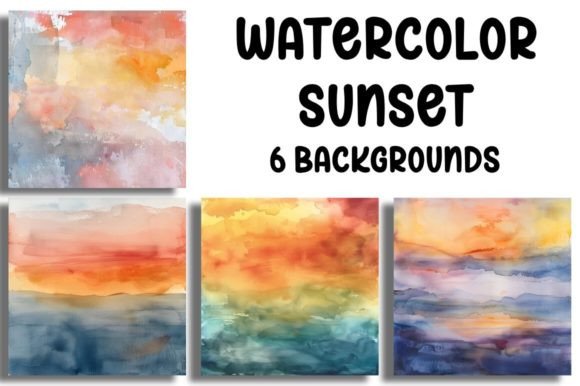
Understanding the visual personality of these assets is key to using them effectively. Watercolor is inherently expressive. It bleeds, it blooms, and it creates gradients that are impossible to replicate mathematically. These specific backgrounds focus on the savanna. You will find the warm, dusty ochres of the Serengeti plains, the deep indigos of an African twilight, and the silhouette-style definitions of acacia trees against setting suns. The style balances realism with abstraction. It does not try to be a photograph; instead, it evokes the feeling of a place.
The "personality" of this collection is warm, adventurous, and grounded. It avoids the cold, sterile feel of modern minimalism. If your brand identity leans toward the natural, the luxurious, or the exploratory, this aesthetic fits perfectly. For a graphic designer, these files act as a bridge between a stark white layout and a rich, immersive visual experience. They provide a backdrop that tells a story before the viewer even reads a single word of text.
Strategic Applications for Creative Professionals
As a creative professional, your assets need to be versatile. The value of a design asset is measured by how many different ways you can use it. Here is how these Safari Landscape Watercolor Backgrounds integrate into various workflows:
- Print and Stationery: This is perhaps the most natural fit. For greeting card designers, these backgrounds provide an immediate "finished" look. A simple serif font overlaid on a watercolor sunset creates a premium product. They are equally effective for notebook covers and journal designs where the cover art needs to be tactile and inviting.
- Digital Marketing and Social Media: In the crowded space of social media graphics, texture stops the scroll. Use these backgrounds for Instagram quotes, podcast covers, or webinar promotion. The organic texture contrasts beautifully with clean, sans serif typography, creating a strong visual hierarchy that draws the eye to your call to action.
- Brand Identity and Packaging: If you are working with a client in the travel, wellness, or artisanal food space, these backgrounds can anchor their branding. Imagine a tea brand packaging design featuring a soft, watercolor savanna illustration. It instantly communicates earthiness and origin. It serves as a creative font backdrop that elevates the entire brand perception.
- Publishing and Editorial: For bloggers and publishers, finding unique featured images is a constant struggle. These files work wonderfully as hero images for travel articles, lifestyle blogs, or even fictional storytelling. They set a mood that standard photography sometimes cannot achieve.
Integrating Assets into Your Design Workflow
Simply placing a background on a canvas is not enough; you need to integrate it with your other design assets to ensure readability and professionalism. When working with rich textures like these, typography selection becomes critical. Because the backgrounds are busy and expressive, you need a typeface that can hold its own without getting lost.
Consider using a premium font with high legibility. A bold, geometric sans serif font often works best for headlines, providing a clean, modern contrast to the organic watercolor edges. If you are going for a more traditional, editorial look, a sturdy serif font with good weight can also work, provided you use a drop shadow or a semi-transparent overlay to ensure the text pops. Avoid overly delicate script fonts or thin handwritten fonts for body copy, as they may become difficult to read against the varying tones of the landscape.
Testing and Evaluation
Before finalizing a project, you must test the background in context. Do not just look at it at 100% zoom on your monitor. Zoom out to see the thumbnail size—does the image still read well? If you are designing for web design, check the load times; while 300 DPI is great for print, you may need to optimize the file size for faster web performance without losing the texture quality.
When evaluating the fit, look at the color temperature. Does the warm ochre of the background clash with the cool blue of your client's logo? Sometimes, applying a simple color overlay or a "Multiply" blending mode in Photoshop can help unify the palette. The goal is to make the background feel like a cohesive part of the design assets, not an afterthought pasted on top.
The Value of High-Resolution Design Assets
In the realm of modern typography and design, quality is non-negotiable. Low-resolution assets can ruin a project, making it look amateurish or untrustworthy. Having access to 4000x4000 pixel files at 300 DPI gives you the flexibility to scale. You can crop into a specific section of the landscape—perhaps focusing on a cluster of trees or a gradient sky—to create a texture for a business card, or you can use the full expanse for a wall art print.
This collection is a commercial font and asset toolkit that respects the needs of professional creators. It acknowledges that you are not just making "pretty pictures"; you are building brand identities, crafting packaging design, and producing editorial design that needs to sell. By removing the background noise and focusing on the timeless beauty of the African landscape, these watercolor files provide a solid foundation for almost any creative vision. They allow you to spend less time searching for the right texture and more time actually designing.